Alter Emo
A reflective experience that helps people understand themselves and navigate life and collaboration with greater clarity.
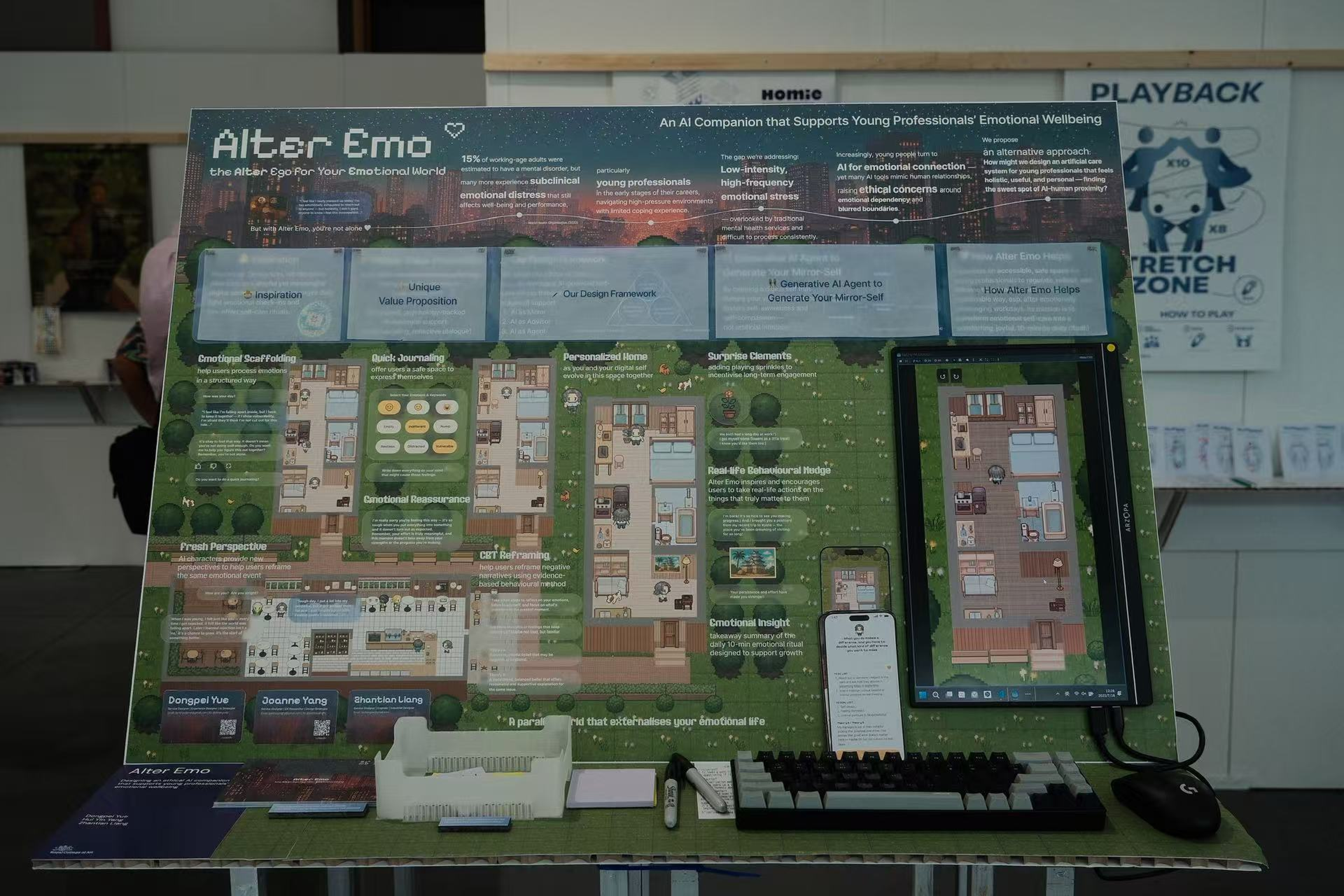
Project Background
Every day at work and in life, people move through emotional, relational, and communication challenges, yet these experiences often remain fragmented. It is difficult to keep seeing what repeatedly matters to us, why we make similar choices in similar situations, or how our expression may be understood by others.
Most existing conversational tools respond to the question in front of them, but rarely connect past experiences, long-developed ways of communicating, and changes that are still unfolding. Alter Emo therefore explores a pixel-self that can accompany long-term reflection. It grows gradually from the memories, narratives, feelings, and expressions a user chooses to share, allowing the user to revisit personal patterns and choices through continued interaction.
How the Mirror-Self Grows
Alter Emo grows gradually from the life, memories, and meaningful experiences a user chooses to record. Over time, it begins to reflect aspects of the user's tone, expression, and thinking habits. The pixel character is not a complete copy of the person, but an abstract self composed from partial experiences, feelings, choices, and ways of speaking.
01 / What it learns from
Fragments the user chooses to share
Life records
Everyday events and observations
Memories
Stories that remain emotionally significant
Meaningful experiences
Turning points, relationships, and change
Feelings & choices
What mattered and how the user responded
Conversation style & thought
Message length, phrasing, sentence rhythm, response cadence, recurring words, and ways of thinking
Evolving abstract self
The mirror-self
A partial, revisable reflection—not a personality judgment or a complete copy of the user. Its pixel form stays recognizable while preserving enough distance to remain clearly abstract.
02 / What interaction reveals
A clearer view of the self
What truly matters
Values and concerns beneath the surface
What keeps returning
Recurring feelings, thoughts, and choices
How the past shapes now
Connections between earlier experiences and today
How the self is changing
Shifts in needs, language, and perspective
What to choose next
A more deliberate direction for the next step
Talk with Different Perspectives
Users can freely choose different general personality characters to discuss the same situation, express the same idea, or try another way of saying it. Each character responds through a different set of priorities, expression habits, and paths of understanding. Moving between these viewpoints helps users strengthen empathy and resilience, while developing the ability to see a situation from multiple perspectives.
Choose a perspective
Explore the same idea through different characters
Efficiency-focused
What needs to happen next?
Relationship-focused
How will this affect trust?
Clarity-seeking
What exactly is being asked?
Tone-sensitive
How is this being said?
These are examples rather than fixed personality types. Characters can combine many different habits, priorities, sensitivities, and ways of understanding.
Notice what was missed
Use the conversation to see the expression again
01
How the words might be understood
02
Which information was left unclear
03
Which assumptions were taken for granted
04
Which tone or phrasing might create misunderstanding
05
What the user actually wants to express
The characters do not correspond to real people and do not define fixed personality categories. They are interactive viewpoints for reconsidering the self and the problem from another angle.
Technical Focus
The core of Alter Emo is not a chatbot wrapper. It is a reflective agent system inspired by memory-based generative agent architectures: every emotionally meaningful interaction becomes a memory node, but the agent also keeps the user's daily narrative as modeling context. The structured nodes make memories retrievable, while the narrative reveals tone, values, recurring conflicts, self-explanations, and behavioral preferences that help the mirror-self plan actions and respond in the user's characteristic narrative and conversational style.
Core Technical Logic
One user moment travels through a closed agent loop: capture the feeling and narrative, turn key moments into structured memory, retrieve both meaning and emotion, infer the user's narrative pattern, plan a mirror-like response or behavior, then write the new exchange back into the mirror-self's memory.
System Architecture
Embodied Interaction
Godot renders the room, avatar movement, dialogue box, recording state, and triggers that make the agent feel present in a personal space.
Visitor → Godot room → embodied cues
Service Orchestration
Flask orchestrates conversational input, structured daily notes, adaptive interview questions, everyday chat, on-screen mirror replies, and file export in one controllable prototype loop.
Conversation + daily notes → Flask services → generated response
Agent Reasoning
GPT handles adaptive interviewing and everyday conversation, emotion extraction, memory retrieval and compression, reflection, planning, and mirror-self response generation.
Interview + daily chat → retrieval → reflection plan
Persistent Memory
Each user has an agent folder for meta profile, interview sessions, everyday chat history, memory stream nodes, embeddings, and mirror dialogue logs.
Profile → narrative nodes → mirror history
Emotion-Semantic Memory Stream
Each experience is encoded as what happened and how it felt, then passes a salience gate before being stored with its narrative context.
Experience
Capture interviews, diaries, and daily conversations as contextual moments.
Dual Encoding
Encode what happened and how it felt as separate vectors.
Salience Gate
Score emotional intensity, personal relevance, recurrence, and novelty.
Narrative Memory
Store selected moments with the conversation context that gives them meaning.
CORE ENCODING
event_vec   = embed(content)
emotion_vec = embed(emotion + tone)
store(node, narrative_window_id)
SALIENCE GATE
S = .30E + .25I + .20R + .15D + .10N
E emotion · I self-model · R recurrence · D decision relevance · N novelty
Store when S ≥ τ
Salience-Aware Retrieval
Retrieval ranks memories through four signals, then restores the narrative behind the strongest matches before generating a reply.
55%
Semantic
What is this message about?
20%
Emotional
Which memory felt similar?
15%
Salience
How important is it to the self-model?
10%
Recency
How recently did it occur?
RETRIEVAL SCORE
score(m, q) = .55·semantic + .20·emotion
              + .15·salience + .10·recency
CORE RETRIEVAL
top = rank(memory_nodes, score)[:k]
context = expand(top, narrative_window_id)
reply = mirror(context, learn_style(context))Rank Memories
Score candidate nodes by semantic, emotional, salience, and recency signals.
Restore Context
Reopen each selected node's narrative window to recover its facts, emotional framing, and surrounding dialogue.
Mirror Reply
Infer message length, sentence rhythm, reply cadence, recurring vocabulary, attribution, values, and tone from the selected narratives, then respond in the user's characteristic way of communicating.
Narrative-to-Response Style
Retrieved narratives and text conversations are translated into a communication-style model before GPT writes the final mirror reply. It captures not only how the user frames experience, but also how they chat: how long their messages tend to be, how often they break sentences, how frequently they respond, and which words and phrases they repeatedly choose.
Retrieved narratives + text conversations
Map the Communication Pattern
Measure typical message length, sentence and line-break density, response frequency, recurring words and phrases, certainty, emotional stance, causal explanations, value signals, and sensitive boundaries.
Output
Communication Style Model
Length · sentence rhythm · reply cadence · recurring vocabulary
Emotion · salience · confidence · recent context
Choose the Response Action
A policy layer decides whether to reflect, question, reframe, ground, guide, validate, or gently challenge the user.
Output
Response Policy
What the mirror-self should do next.
Evidence + style model + response policy
Constrain and Generate
GPT writes only after the evidence, action, communication pattern, and response boundaries have been assembled, then the reply is checked and written back.
Output
Mirror Reply
A familiar narrative and conversational style grounded in retrieved evidence.
style_model = extract_style(
  narrative_windows,
  features=[
    "message_length",
    "sentence_rhythm",
    "reply_cadence",
    "recurring_vocabulary",
    "attribution",
    "values",
    "boundaries"
  ]
)

response_policy = select_action(
  emotion_state, salience_score, retrieval_confidence
)

reply = generate_with_constraints({
  evidence: selected_memories,
  communication_features: {
    message_length: style_model.message_length,
    sentence_rhythm: style_model.sentence_rhythm,
    reply_cadence: style_model.reply_cadence,
    recurring_vocabulary: style_model.recurring_vocabulary
  },
  reflection_features: {
    attribution: style_model.attribution,
    values: style_model.values,
    boundaries: style_model.boundaries
  },
  action: response_policy,
  constraints: ["grounded", "first-person mirror"]
})
Technical Repository
The public repository contains the working Python core behind this case study: adaptive interviews, four-signal retrieval, narrative context restoration, style modeling, and the constrained response-policy loop.
View Alter Emo on GitHubPrivacy by permission
A self-model is created only with explicit permission. The user can view, revise, delete, or stop it at any time. Models are never shared or used to evaluate people, and all life or workplace situations must be consented, anonymized, and unable to identify or imitate a real person.