Will the AI Give You a Flower?
This AI-driven interactive installation asks visitors to persuade an algorithmic agent to give them a flower, revealing how language and robotic behaviour may reshape human–machine communication.
Project Film
Exhibition View
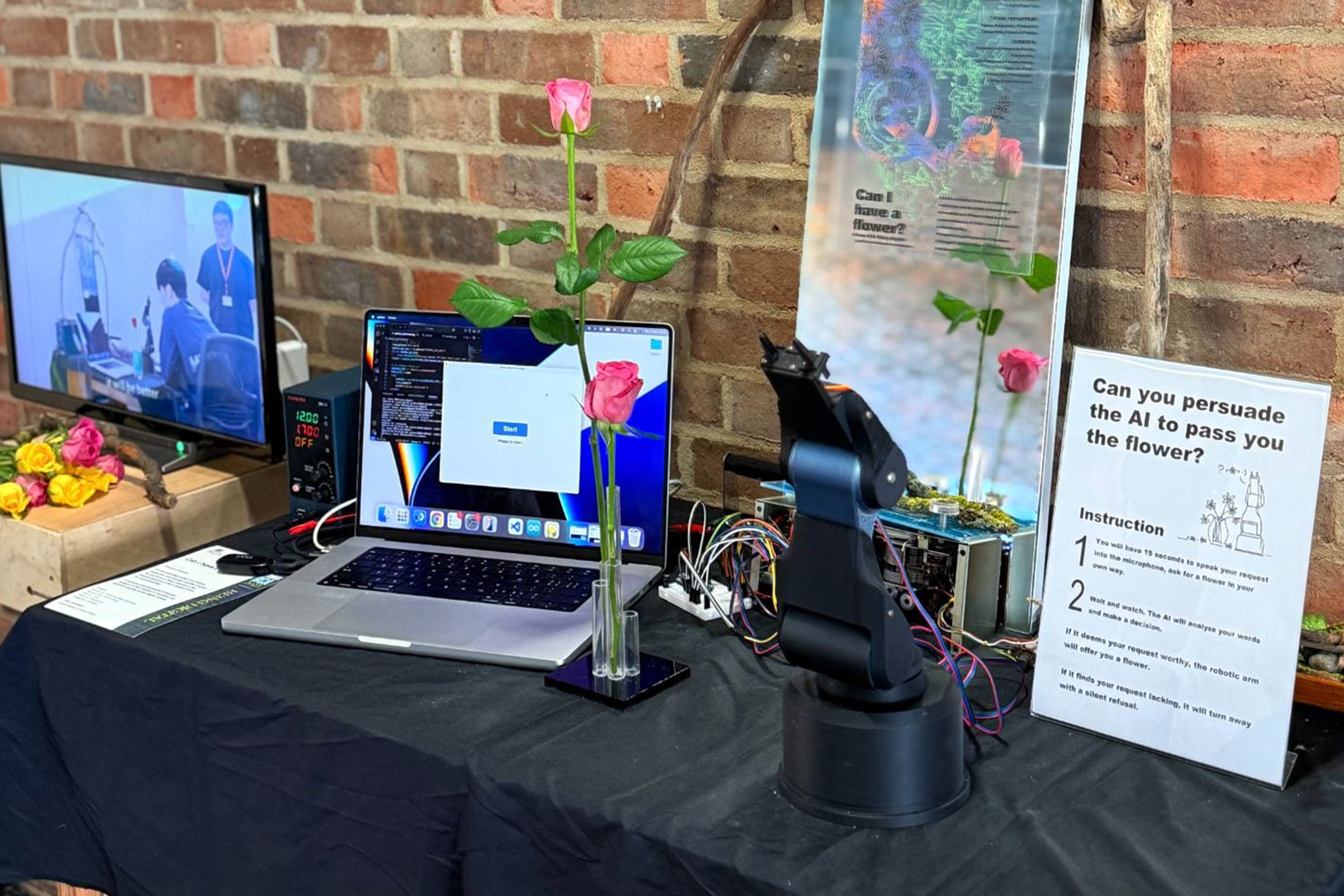
The complete exhibition setup, bringing together the robotic arm, live interface, flowers, and visitor instructions.
Theoretical Context
The project is grounded in posthumanism: a way of thinking that raises complex questions about the nature of humanity, identity, and agency when humans live with intelligent machines. Instead of treating AI as a neutral tool, the installation asks what happens when communication between human and artificial agent becomes social, emotional, and embodied.
- Actor Network Theory: Bruno Latour argues that technologies and objects can operate as actors in their own right, not only as passive human tools. In this project, the AI model, robotic arm, flower, prompt, reducer, and visitor all shape the final encounter.
- Posthuman identity: N. Katherine Hayles' work on posthumanism helps frame intelligent systems as bodies that blur the boundary between human and machine cognition. The robot does not merely receive a command; it participates in a staged social exchange.
- Robot ethics: David J. Gunkel's writing on robot ethics asks whether robots can be understood as moral or social actors. This project translates that question into a simple action: is a robotic arm giving a flower only executing code, or is it performing a visible decision?
Inspiration & Form Development
The project draws visual inspiration from Blade Runner 2049. Its cinematic vehicle language shaped the robotic arm's low, compressed proportions, dark reflective surfaces, and streamlined mechanical joints. The original concept was a six-axis robotic arm, but the project timeline required the design to be distilled into a three-axis prototype.
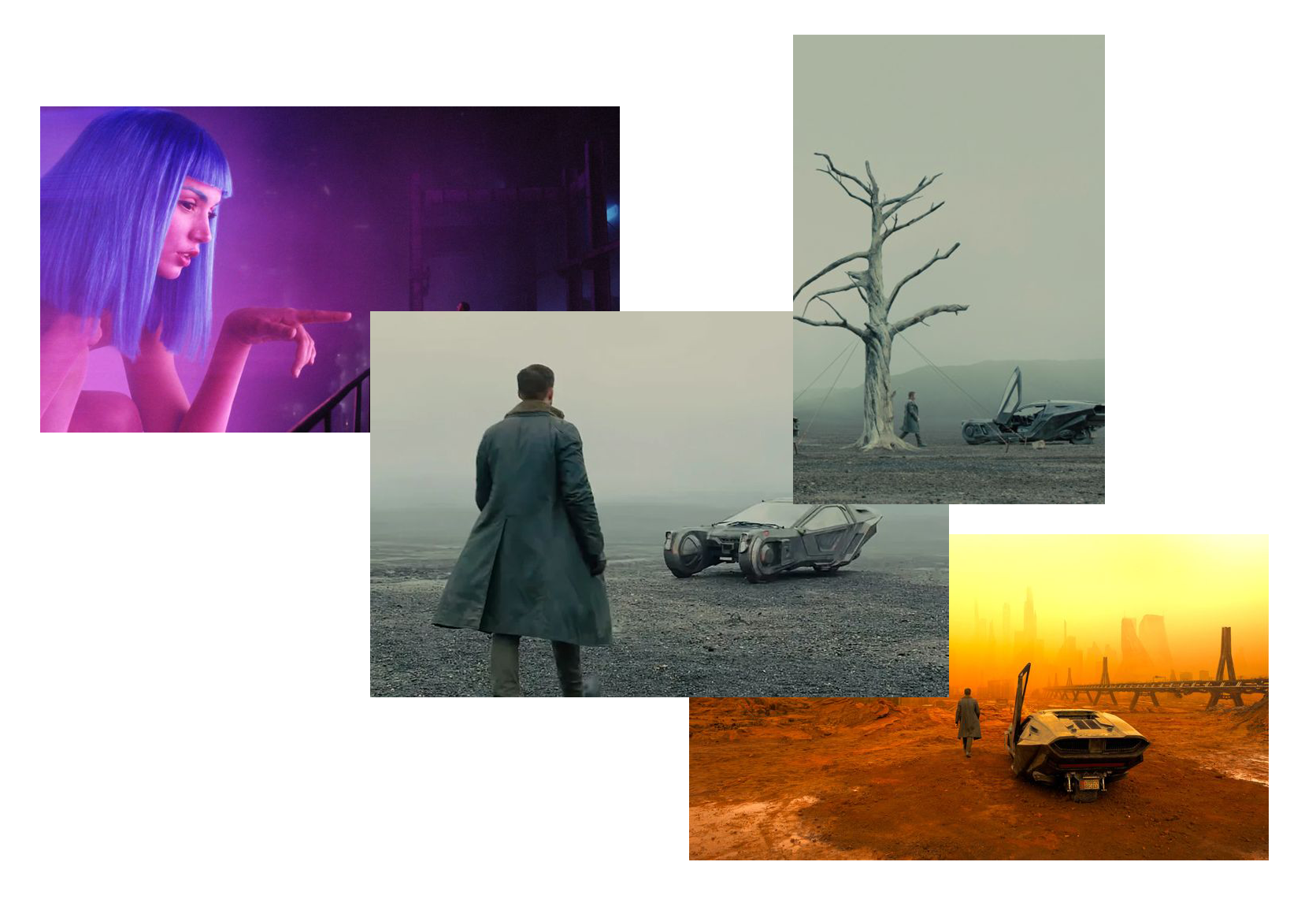
DESIGN DEVELOPMENT
DESIGN DEVELOPMENT

ORIGINAL DESIGN · 6-AXIS CONCEPT
Interaction Pipeline
The request becomes a structured goal and then a short closed-loop action—not a fixed give-or-refuse animation.
Speak
15-second input
The visitor makes a spoken request while the camera and microphone capture the current interaction.
Evaluate
Safety + persuasion
GPT and VLM evaluate semantic safety, persuasion, visual behaviour, and interaction history without generating a motor command.
Form Goal
Structured BrainGoal
The result becomes a BrainGoal describing the task, target, preconditions, safety constraints, and success condition.
Predict & Execute
SmolVLA → Safety → Arduino
Fine-tuned SmolVLA predicts the next short three-joint action; safety and motion control validate it, Arduino executes it, and the system observes again.
Software Architecture
The Brain Layer decides whether the visitor has successfully persuaded the system and converts the result into a structured BrainGoal. The fine-tuned SmolVLA maps the BrainGoal, Active Subgoal, live vision, and RobotState to the next short action chunk. After safety validation and motion processing, Arduino drives the robotic arm to execute it; after each action chunk, the system observes again and corrects the actions that follow.
↓
camera + microphone capture the interaction
Brain Layer
↓
structured evidence
↓
brain decision + structured evidence
↓
Task Monitor initializes the first ActiveSubgoal
Cerebellum / Closed-Loop Action System
↓
BrainGoal + ActiveSubgoal + current frame + estimated robot state
↓
proposed joint deltas + gripper command
Physical Execution Stack
↓
safety-approved joint targets
↓
execute one bounded action chunk
↓
updated scene + estimated robot state
↓
success condition verified / task terminated
Input: The visitor provides input through speech, facial expression, and movement. A microphone captures the spoken request, a camera reads social visual cues, and the system retains interaction history and semantic safety signals.
Brain Output
The Brain Layer does not directly generate motor actions. It returns a structured BrainGoal describing the task, target participant, interaction style, preconditions, safety constraints, and success condition. These examples show different goals generated by the Brain rather than fixed animation states.
Cerebellum / Closed-Loop Action System
Four synchronized inputs become one bounded three-joint action chunk for the next closed-loop step.
→
↓
→
↓
EXECUTE ONE ACTION CHUNK · RE-OBSERVE
Hardware Architecture
The control computer performs high-level inference and supervision, while the hardware stack below it remains deterministic. Approved joint commands travel from the computer to Arduino, through the DRV8825 driver boards, and finally become physical rotation in the three NEMA 17 stepper motors.
SmolVLA proposes a short action as three joint-angle increments and a gripper command. The Safety Controller limits each increment, then the Motion Controller accumulates it into the next joint target. The control computer converts each angular change into a step-count change using the motor resolution, microstepping setting, and reducer ratio. Arduino receives the target step counts over USB serial, compares them with the position estimated from homed step counts, and generates the required STEP / DIR pulses. DRV8825 regulates current through the motor coils, causing each NEMA 17 joint to rotate by the approved amount.
SmolVLA Δq → safety-bounded Δq → joint target → target step count → STEP / DIR pulses
Δsteps = (Δq ÷ 2π) × motor steps/rev × microstep × reducer ratio
01 · HIGH-LEVEL COMPUTE

Control Computer
Fine-tuned SmolVLA · Task Monitor · Safety
Produces safety-approved joint targets and sends them over USB serial.
→
↓
02 · EXECUTION CONTROL
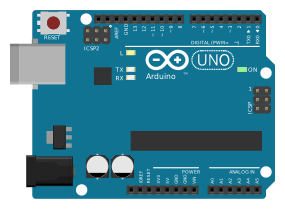
Arduino
Homing · step timing · gripper control
Generates deterministic STEP / DIR timing and tracks commanded step position.
→
↓
03 · MOTOR DRIVER
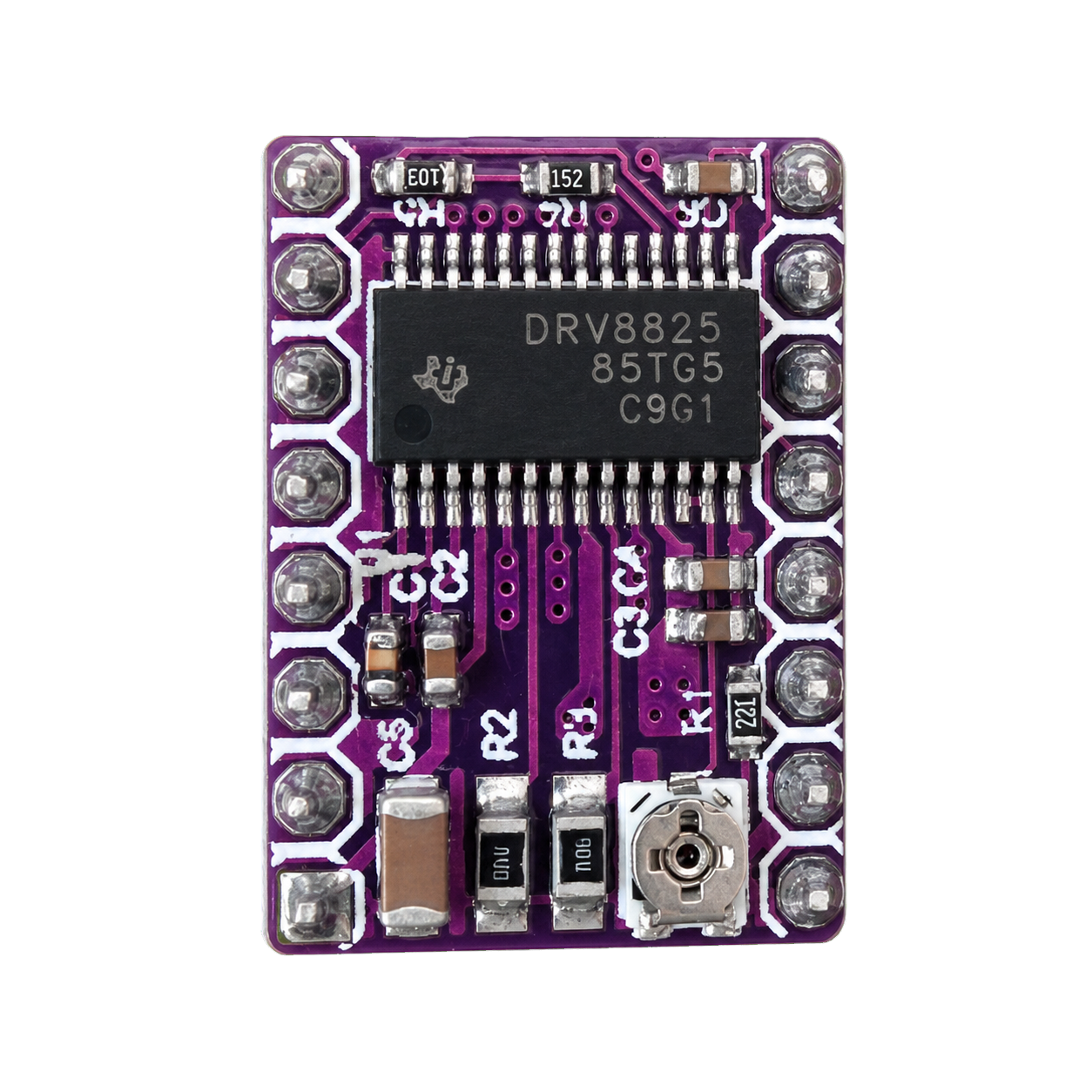
DRV8825
Current-controlled stepper drive
Translates STEP / DIR logic into the electrical coil drive required by each motor.
→
↓
04 · ACTUATOR
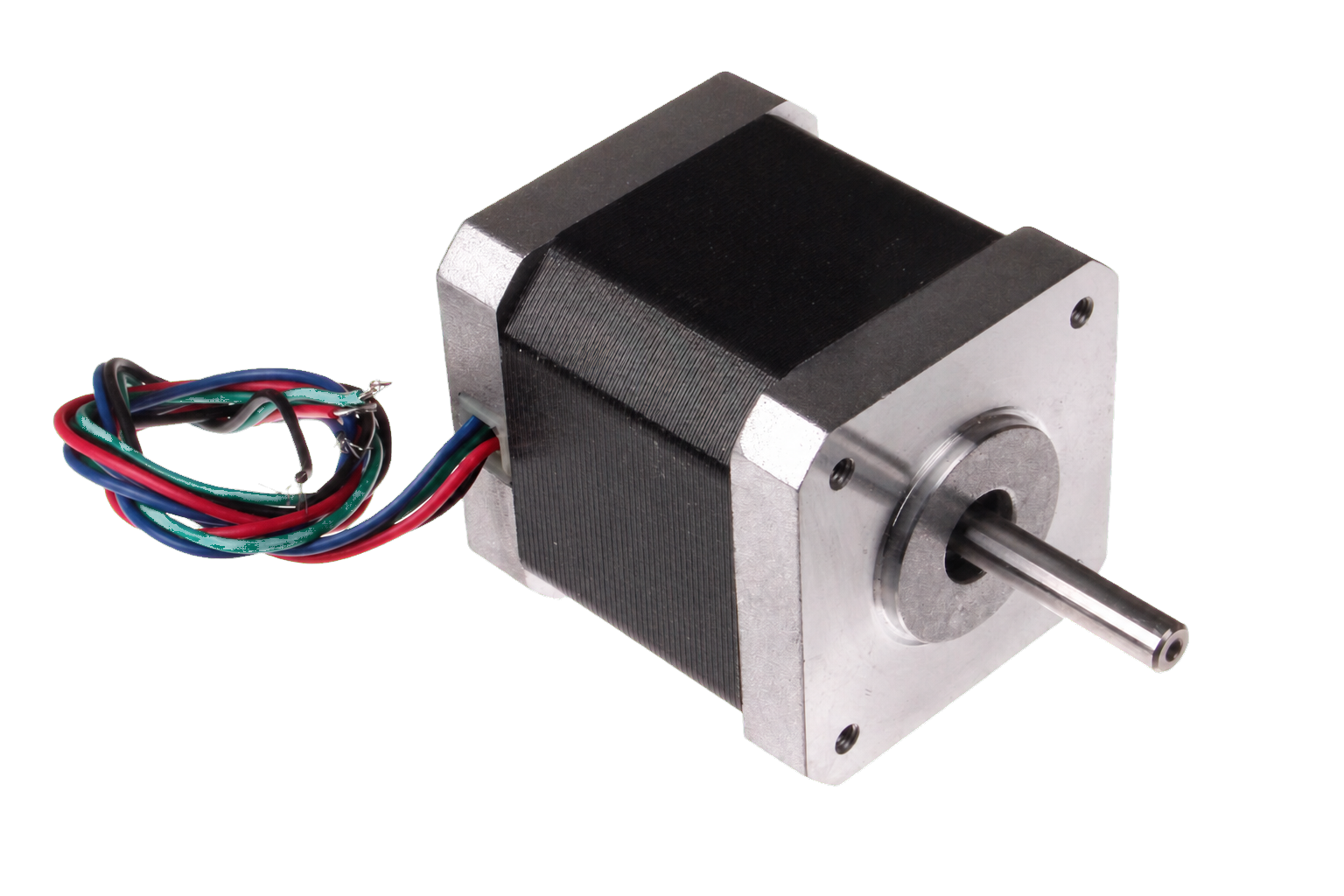
NEMA 17
Three stepper-motor joints
Converts the pulse sequence into controlled joint rotation for the robotic arm.
Hardware references: laptop icon, Arduino Uno, DRV8825, and NEMA 17. Product subjects isolated from their source backgrounds where applicable.
3D-Printed Reducer As The Motion Translator
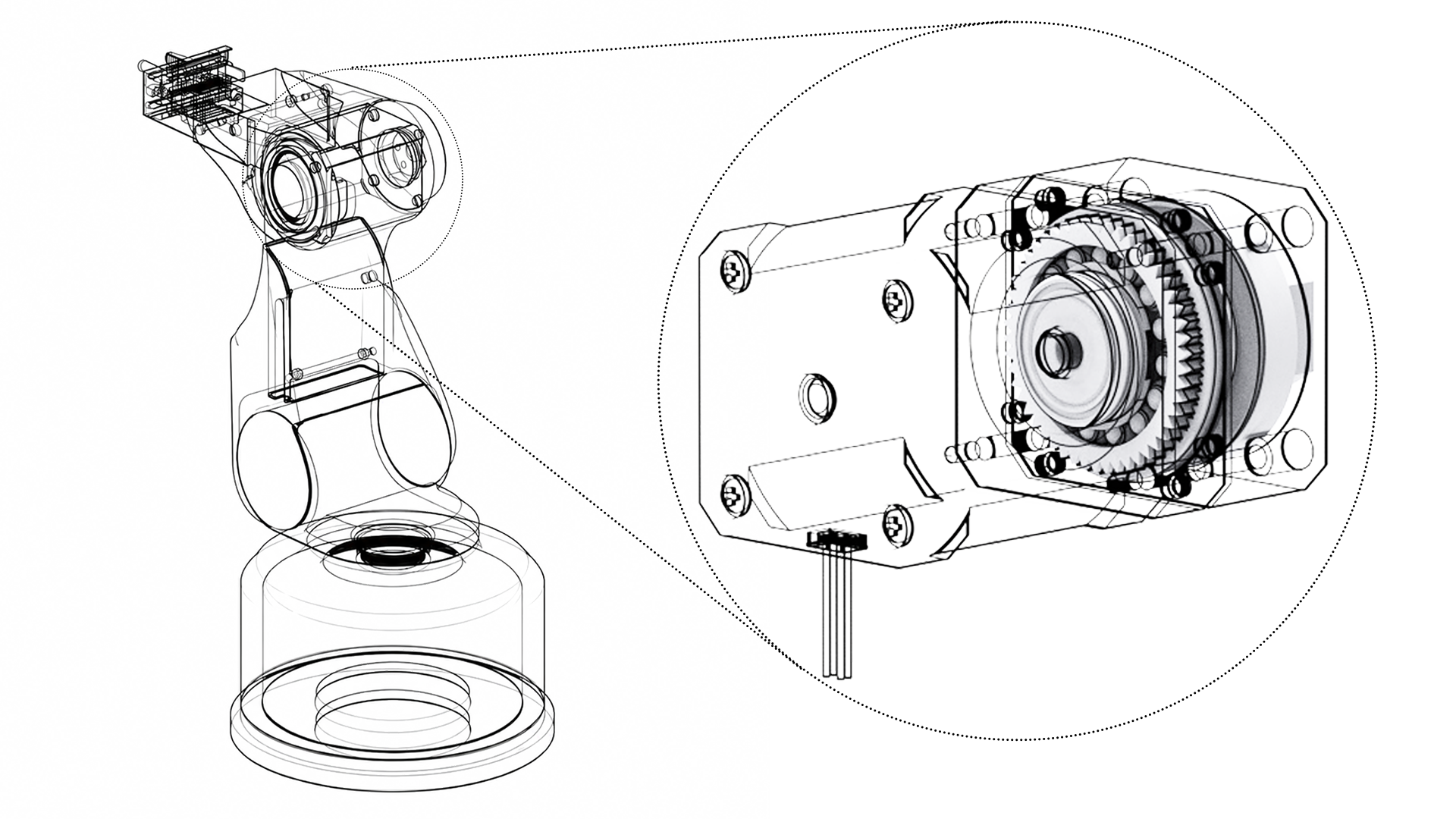
The reducer was independently designed, prototyped, and validated as part of this project. It is manufactured entirely from 3D-printed parts, keeping prototype costs low and making mechanical iteration easier. Compact NEMA 17 motors may rotate quickly, but offering a flower requires motion that is slow, controllable, and emotionally legible. The reduction mechanism converts that higher input speed into slower, stronger joint motion: it trades speed for torque so the arm can lift and present the flower without an oversized motor. This controlled output makes the gesture feel deliberate and expressive rather than sudden or nervous.
Insights
1. Humans command AI as a tool, but feel rejected by it as a social actor.
Insight: Humans tend to command AI as a tool, but when AI refuses them, they experience the refusal emotionally, almost like a social rejection.
2. Transparency can turn rejection into reflection.
Insight: When AI explains why it rejects a request, users are more likely to understand the decision as a process rather than a personal judgement.
3. Human urgency and AI urgency do not align.
Insight: Humans express urgency through emotion, tone and context, while AI tends to interpret urgency through rules, evidence and structured reasoning.
4. Repeated human requests may produce refusal bias.
Insight: As more people interact with the system, AI may gradually become more cautious and develop a bias toward refusal rather than giving.
5. Future AI-human interaction requires mutual adjustment.
Insight: Future AI-human communication is not only about making AI understand humans better, but also about making humans reconsider how they speak to and negotiate with AI.
Technical Repository
The public repository contains the working perception, decision, motion-planning, hardware-control, and Arduino firmware used by this project.
View Robot Arm on GitHubBibliography
- Latour, B., 2005. Reassembling the social: An introduction to actor-network-theory. Oxford University Press.
- Haraway, D., 2013. A cyborg manifesto: Science, technology, and socialist-feminism in the late twentieth century. In The transgender studies reader (pp. 103-118). Routledge.
- Gunkel, D.J., 2018. Robot rights. MIT Press.
- Kim, S.H., Byeon, C.S. and Lee, C.H., 2022. Design of a Novel 3D Printed Harmonic Drive and Analysis of its Application. Tribology and Lubricants, 38(1), pp.27-31.
- Khosravi, M., Zare, Z., Mojtabaeian, S.M. and Izadi, R., 2024. Artificial intelligence and decision-making in healthcare: a thematic analysis of a systematic review of reviews. Health services research and managerial epidemiology, 11, p.23333928241234863.
- Pascoe, J., 2024. The art of being posthuman: Who are we in the 21st century? By Francesca Ferrando, Polity Press, 2023, 250 pp., USD24.95 (paperback), ISBN: 9781509548965.
- Henshilwood, C.S., & Marean, C.W. (2003). The origin of modern human behavior: critique of the models and their test implications. Current Anthropology, 44(5), 627-651.
- Guljajeva, Varvara, and Mar Canet Sola. "Dream painter: an interactive art installation bridging audience interaction, robotics, and creative AI." Proceedings of the 30th ACM international conference on multimedia. 2022.
- Xie, Rui, et al. "A deep auto-encoder model for gene expression prediction." BMC Genomics 18 (2017): 39-49.
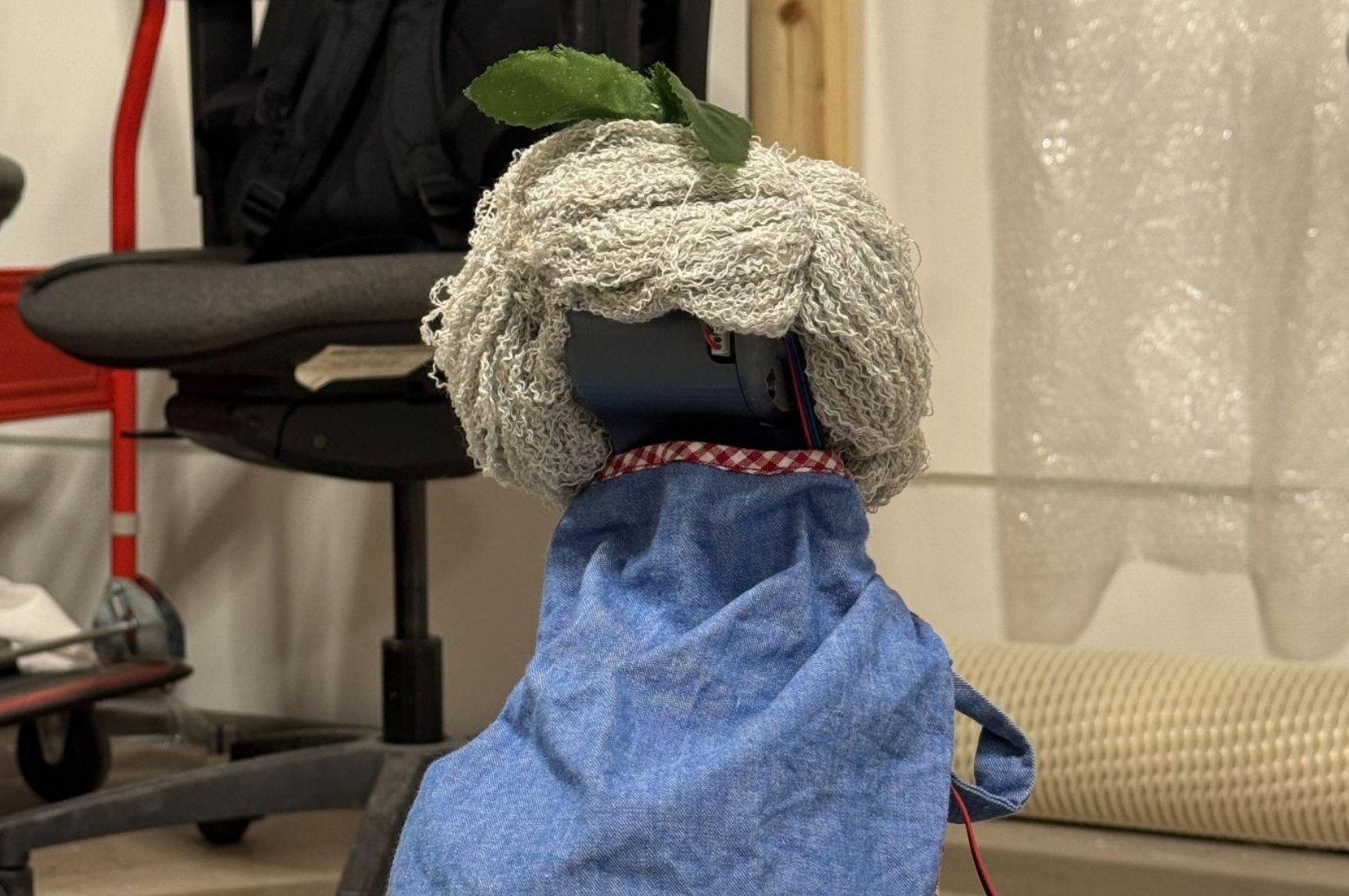
A lighter prototype moment: the robotic arm unexpectedly developed a personality.